
Chalkidiki Property Market Report
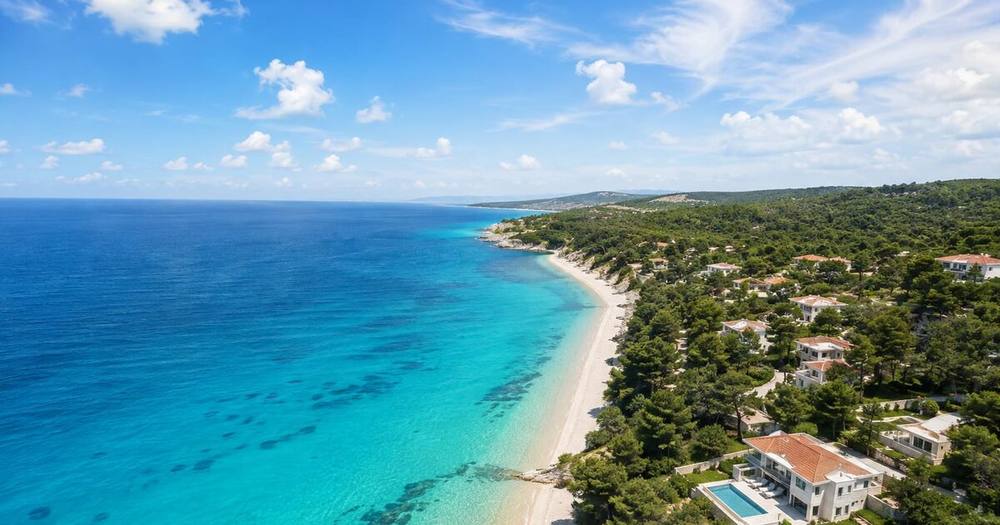
Chalkidiki Property Market Report
Compiled by the local team at Chalkidiki Real Estate · figures dated at source · last reviewed August 2026
Chalkidiki is the most expensive holiday-home market in mainland Greece and one of the fastest-growing regions in the country — yet it is barely covered in national property reporting, which concentrates on Athens, Thessaloniki and the islands. This report brings together the available data for the region, puts it in national context, and explains what it means in practice for people buying, owning and letting property here.
Every figure is sourced and dated. Where a number is an asking price rather than a completed sale, we say so. Where no reliable data exists for Chalkidiki specifically, we say that too, rather than presenting a national average as if it were local.
The report is written for four kinds of reader: people buying a holiday home or a permanent residence, owners weighing rental income against personal use, investors comparing Chalkidiki with other Mediterranean markets, and journalists or analysts who need regional figures they can quote.
On this page
- Key figures at a glance
- What property costs in Chalkidiki
- How Chalkidiki compares nationally
- How the market reached this point
- The five sub-markets in detail
- Who is buying
- Capital, Golden Visa and the €400,000 band
- What it costs to buy: taxes and fees
- What it costs to own
- Rental market, tourism and returns
- Short-term rental rules
- What the statistics cannot see
- What the data means for buyers
- Risks and what could change
- Glossary of Greek property terms
- Methodology and sources
- Frequently asked questions
Key figures at a glance
| Indicator | Value | Period | Source |
|---|---|---|---|
| Asking price, Sithonia | €3,000 /m² | Q2 2026 | Spitogatos |
| Asking price, Kassandra | €2,895 /m² | Q2 2026 | Spitogatos |
| Asking price, Kallikratia | €2,513 /m² | Q2 2026 | Spitogatos |
| Prime beachfront, upper end | up to €14,000 /m² | 2026 | Engel & Völkers |
| Apartment prices, “other areas” of Greece | +6.9 % year-on-year | Q1 2026 | Bank of Greece |
| Apartment prices, Greece overall | +5.7 % year-on-year | Q1 2026 | Bank of Greece |
| Asking prices, all housing, Greece | +6.1 % year-on-year | Q2 2026 | Spitogatos |
| National house price index | 111.9 points (all-time high; 2007 = 100) | Q1 2026 | Bank of Greece |
| Recovery from the 2017 trough | roughly +90 % | Q3 2017 → Q1 2026 | Bank of Greece index |
| Foreign share in leading second-home markets | 60–85 % of purchases | 2026 | Engel & Völkers |
| Net foreign direct investment in Greek real estate | €511.6 m (+43.4 %) | Q1 2026 | Bank of Greece |
| Golden Visa applications, Greece | 1,236 (−57.8 %) | Q1 2026 | Ministry of Migration data |
| Property transfer tax | 3.09 % (3 % + 0.09 % municipal) | 2026 | Greek tax code |
| Total purchase costs on top of price | typically 5–7 % | 2026 | market practice |
| Average gross rental yield, Greece | 4.38 % | May 2026 | Global Property Guide |
| Licensed hotel beds, Chalkidiki | 49,069 in 496 hotels | end 2024 | Hellenic Chamber of Hotels |
| Tourist season length | approx. 190 days | 2024/25 | industry data |
Each figure is explained in context below, including what it does and does not measure.
What property costs in Chalkidiki
The most reliable regional figures come from asking-price data on Greece’s largest property portal. For the second quarter of 2026:
- Sithonia: €3,000 per square metre — the highest level recorded anywhere in northern Greece
- Kassandra: €2,895 per square metre
- Kallikratia: €2,513 per square metre
These are the prices sellers ask, averaged across everything currently listed — apartments, houses and villas, new and old, first line and inland. They are not what buyers finally pay, and they cannot replace a valuation of a specific property. Agreed prices in Greece are not published at municipal level, so no source can honestly claim to show them.
At the top of the market the picture changes completely. Engel & Völkers puts prime beachfront in Chalkidiki at up to €14,000 per square metre in its 2026 second-home report — the highest figure quoted for any Greek destination in that report, ahead of Mykonos at €12,000 and Paros at €10,000.
Price bands by position
Averages hide the pattern that actually determines what a property costs here: how far it sits from the water. Agency market observations for the two main peninsulas put the bands at roughly the following levels.
| Position | Kassandra | Sithonia |
|---|---|---|
| Front line / direct beach access | €2,800–4,500 /m² | €2,400–4,000 /m² |
| Second line (5–10 minutes on foot) | €2,100–3,200 /m² | €1,800–2,800 /m² |
| Inland villages and green hinterland | €1,400–2,200 /m² | €1,300–2,100 /m² |
The step from front line to second line costs roughly a third of the price per square metre — often for a property five minutes’ walk from the same beach. For buyers working to a fixed budget this single decision usually matters more than the choice of village, and it is the first thing we discuss when a brief arrives.
Read in the other direction, the same numbers describe an opportunity. Chalkidiki reaches island-level quality at the top while its typical asking prices sit around €3,000 per square metre — roughly a third of Mykonos or Paros. For buyers who want a serious property on the sea rather than a postcode, mainland Greece remains substantially better value than the Cyclades.
What drives the price of an individual property
Beyond position, five factors explain most of the variation we see between properties that look comparable on paper.
Legal and building status. A property with a complete permit history, no unauthorised extensions and a clean topographic diagram is worth materially more than an otherwise identical property with open issues — because the second one will need to be regularised before it can be sold on, and the buyer prices that risk in.
Plot and buildability. Two neighbouring plots can differ sharply in value depending on zoning, minimum plot size for building, distance from the shoreline, forest-registry status and road frontage. In parts of Chalkidiki the buildable area on a plot is the single largest driver of its price.
Orientation and view. Sunset-facing plots on the western side of Kassandra and elevated positions with an unobstructed sea view carry a premium that has widened rather than narrowed over the past decade.
Year-round usability. Insulation, heating, road access in winter and proximity to a town that stays open outside the season increasingly separate holiday-only properties from those suitable for permanent living — and the second group has been gaining value faster as relocation demand grows.
Condition and energy performance. Many properties built in the 1990s and 2000s were optimised for summer use. Bringing one up to modern comfort and energy standards is a predictable cost, and buyers increasingly deduct it from what they are willing to pay.
How Chalkidiki compares nationally
The Bank of Greece publishes the only official price index, compiled from data supplied by all credit institutions operating in Greece. For the first quarter of 2026 it reports apartment prices up 5.7 % year-on-year nationally — a clear slowdown from the 8.1 % recorded across 2025.
The regional breakdown is where Chalkidiki becomes interesting:
| Area | Year-on-year change, Q1 2026 |
|---|---|
| Athens | +5.2 % |
| Thessaloniki | +6.4 % |
| Other cities | +5.4 % |
| Other areas of Greece (includes Chalkidiki) | +6.9 % |
Chalkidiki falls into the last category — the fastest-growing of the four. The pattern repeats across sources: growth has shifted away from Athens and towards accessible mainland coastal regions. Asking prices show the same deceleration nationally, from +9.7 % a year earlier to +6.1 % in the second quarter of 2026, while Thessaloniki asking prices rose 7.7 %.
Two conclusions follow. The market is still rising, but the era of double-digit national growth has ended. And Chalkidiki sits in the segment that is outperforming — carried by demand for coastal second homes rather than by urban housing shortage.
It is worth being precise about what the official index does and does not cover. It is built on apartment valuations submitted by banks in connection with lending. Chalkidiki’s market is dominated by detached houses, villas and building plots, frequently bought without a Greek mortgage. The index therefore describes the direction of the wider market accurately, but it is not a measure of what a beachfront villa in Sithonia is worth. That is why we read it alongside portal asking prices rather than instead of them.
How the market reached this point
Understanding today’s prices requires knowing what came before them. The Greek residential market has moved through four distinct phases in under a decade, and Chalkidiki has experienced each of them differently from Athens.
The trough: 2013–2017
The Bank of Greece index bottomed out at 58.9 points in the third quarter of 2017, against a base of 100 for 2007. In plain terms, residential property had lost roughly 40 percent of its nominal value from the pre-crisis peak. Transactions were thin, bank lending had all but stopped, and a substantial share of what did sell went to buyers paying cash. Holiday-home markets like Chalkidiki were hit hard: discretionary purchases are the first to disappear in a debt crisis.
The recovery: 2018–2021
Prices turned in 2018 and rose in every subsequent quarter. Three forces drove the recovery: international buyers taking advantage of prices that looked cheap against other Mediterranean markets, the Golden Visa programme in its original form with a €250,000 threshold, and the rapid growth of short-term letting, which turned residential property into an income asset for a much wider group of owners.
The boom: 2022–2024
Post-pandemic demand, remote work, and a broad international search for second homes with outdoor space produced the fastest price growth Greece had seen in a generation. Coastal and island markets ran ahead of the cities. Buyers frequently decided within days, and in the strongest locations properties sold without ever appearing publicly. It is the phase that shaped many buyers’ expectations — and the reason some still arrive expecting to have to decide in a weekend.
Normalisation: 2024 to today
Two things changed. Law 5100/2024 raised Golden Visa thresholds sharply, cutting off the lower end of investment-driven demand. And the pace of price growth slowed from double digits to the 5–7 percent range now recorded. The index reached 111.9 points in the first quarter of 2026, an all-time high and roughly 90 percent above the 2017 trough — but the rate of change has halved.
The distinction matters. A market rising 6 percent a year is not a market in trouble; it is a market that has stopped being frantic. Buyers now have room to compare, visit, negotiate and carry out proper checks — something that was genuinely difficult in 2022. The advantage in this phase belongs to buyers who have local access and see suitable properties early, rather than to those who simply move fastest.
The five sub-markets in detail
Chalkidiki is administratively one regional unit, but for buyers it behaves as five separate markets with different price levels, buyer profiles and seasonal patterns.
Kassandra — the developed peninsula
The first of the three “legs” is the most developed and the most liquid. Kallithea, Pefkohori, Hanioti, Polichrono, Sani and Nea Fokea form an almost continuous ribbon of resorts, restaurants, marinas and beach clubs. Infrastructure is the best in the region, the drive from Thessaloniki airport is the shortest of the three peninsulas, and rental demand in July and August is close to guaranteed for a well-presented property near a good beach.
Asking prices averaged €2,895 per square metre in the second quarter of 2026. Front-line property ranges from roughly €2,800 to €4,500 per square metre, with a small number of exceptional beachfront positions well above that. Inland villages on the same peninsula start closer to €1,400.
Kassandra suits buyers who want services, activity and straightforward letting. It suits less well those looking for seclusion: in August the peninsula is busy, and the roads show it. Property for sale in Kassandra.
Sithonia — the nature-first peninsula
The middle leg is the most expensive in northern Greece by asking price, at €3,000 per square metre, and the reason is scarcity rather than infrastructure. Sithonia is pine-covered, hilly and far less densely built. Vourvourou, Kalamitsi, Porto Koufo and the coastline around Sarti offer coves and views that simply do not exist on Kassandra, and the protected character of much of the peninsula limits how much new supply can ever be created.
Nikiti is the practical centre: a real town that stays open in winter, with schools, medical services and shops, which makes it one of the few places in Sithonia genuinely suited to year-round living. Neos Marmaras combines a marina and resort infrastructure with access to the quieter south.
Sithonia suits buyers prioritising landscape, privacy and long-term scarcity value. It demands more of them in return: greater driving distances, fewer year-round services, and in the remoter bays, careful attention to water, power and internet supply. Property for sale in Sithonia.
The Athos area — authenticity and lower entry prices
The third leg and its approaches — Ouranoupoli, Ierissos, Nea Roda, Ammouliani island and the mountain villages around Arnea and Stagira — form the most traditional part of Chalkidiki. Tourism is present but has not reshaped the settlements the way it has on Kassandra. Prices sit noticeably below the two western peninsulas, and buyers here are typically looking for character, quiet and a village that functions outside the season.
The Mount Athos monastic state next door shapes the area: it constrains development, brings a steady stream of pilgrim visitors through Ouranoupoli, and gives the region a cultural profile no other part of Chalkidiki has. Property for sale in the Athos area.
Polygyros and the inland belt — year-round living
The administrative centre of Chalkidiki and the villages around it — Taxiarchis, Galatista, Vavdos, Arnea and the Holomontas mountain area — make up the market with the lowest entry prices and the least seasonality. Buyers here are usually not looking for a beach house. They want a permanent home, a countryside property, cooler summers at altitude, or a base within half an hour of both the sea and Thessaloniki.
This belt has quietly become more interesting as relocation demand grows. A buyer who intends to live in Greece rather than visit it will often get more house, more land and lower running costs a short drive inland than on the coast. Property for sale in Polygyros.
Nea Moudania and the northern coast — the practical option
Nea Moudania is the largest town in Chalkidiki and functions as its commercial gateway: supermarkets, banks, schools, a hospital, a marina and a year-round population. Together with Flogita, Dionysiou Beach, Nea Potidea and Agios Mamas, the northern coastal strip offers sea access with full urban services and prices below both western peninsulas.
Kallikratia, just outside the regional boundary but part of the same commuter belt, showed asking prices of €2,513 per square metre in the second quarter of 2026 — the most affordable of the three Chalkidiki-area figures reported by the portal, and a useful benchmark for what proximity to Thessaloniki is worth. Property for sale in Nea Moudania.
Who is buying
International buyers dominate the Greek second-home market: Engel & Völkers estimates that between 60 and 85 percent of purchases in leading destinations are made by foreign buyers.
The nationalities differ by region, and Chalkidiki has a profile of its own. Alongside the countries that drive the national market — Germany, the United Kingdom and the United States — northern Greece draws heavily on Bulgaria, Serbia, Romania and North Macedonia, whose buyers arrive by car in a few hours. Analyses of portal search data name southeastern and central Europe specifically for this region, and the tourism statistics point the same way: Romania is the largest single source market for Central Macedonia, and North Macedonia alone accounts for an estimated one million visitors a year to the wider region.
That road accessibility is a structural advantage no island market can copy. It also explains why Chalkidiki behaves differently from the Cyclades: a meaningful share of its demand is regional rather than intercontinental, and therefore far less exposed to airline capacity, flight prices and the length of the flying season.
Four buyer profiles and what they typically look for
The Central European family holiday home. German, Austrian and Swiss buyers, usually looking for a three- or four-bedroom house within walking distance of a beach, with a pool or the space for one, used four to eight weeks a year and let for part of the remaining season. Legal certainty and building status matter more to this group than to any other; they generally want everything documented before they proceed.
The Balkan weekend property. Buyers from Bulgaria, Serbia, Romania and North Macedonia who can drive to their property in three to six hours. Because travel is cheap and spontaneous, they use their properties far more often than fly-in owners, frequently outside the peak season, and they place more weight on a place that works in April and October than on maximum rental yield.
The relocation or retirement buyer. Increasingly common since the growth of remote work and the pension provisions that make Greece attractive to retirees. This group cares about year-round infrastructure, healthcare access, winter road conditions, insulation and heating — and often ends up inland or in a town like Nikiti or Nea Moudania rather than in a resort.
The investor. Buyers whose primary measure is return: rental performance, the length of the letting season, management cost, and resale liquidity. This group is the most sensitive to the short-term rental rules described below, and the most likely to consider a portfolio of smaller units rather than one large property.
Capital, Golden Visa and the €400,000 band
Two figures from the first quarter of 2026 tell a story that is easy to misread if they are taken separately.
- Net foreign direct investment in Greek real estate: €511.6 million, up 43.4 % year-on-year
- Golden Visa applications: 1,236, down 57.8 % year-on-year
Foreign capital flowing into Greek property is growing strongly while the residence-by-investment route is shrinking. The decline follows the higher thresholds introduced by Law 5100/2024, which raised the minimum investment to €800,000 in the prime zones. What the numbers show is that buyers did not leave — the programme simply stopped being their main reason to buy.
For Chalkidiki this matters directly. The region sits outside the €800,000 prime zones, in the €400,000 threshold band that covers most of Greece, with a minimum property size of 120 m², a single-property rule and a ban on short-term letting of the qualifying property. Chalkidiki is therefore one of the few regions where the residence route remains open at half the Athens entry price — while most demand here comes from buyers who want the house first and the permit second.
The practical consequence for anyone combining the two objectives is that the property has to be chosen for both. A 120 m² minimum rules out a large share of the apartment stock; the single-property rule means the whole investment must sit in one asset; and the letting ban means the property cannot be run as a holiday rental while it underpins the permit. Buyers who plan to let should be clear about which of the two goals takes priority before they start viewing.
The full rules, including the procedural changes brought by Law 5275/2026, are set out in our Golden Visa Greece guide.
What it costs to buy: taxes and fees
The purchase price is only part of what a buyer pays. Greek acquisition costs are moderate by European standards, but they are frequently misstated online — particularly the VAT question — so it is worth setting them out precisely.
Property transfer tax
The standard rate is 3 percent of the taxable value, plus a municipal surcharge of 0.09 percent, giving an effective 3.09 percent. It is paid by the buyer before the notarial contract is signed. The tax is calculated on the higher of the declared price and the objective (tax-assessed) value, which in some areas differs materially from the market price.
VAT on new-build property — the most misunderstood item
New-build property in Greece is in principle subject to 24 percent VAT instead of transfer tax. That VAT has been suspended, and the suspension currently runs to 31 December 2026 under Law 5246/2025. Eligible new-build purchases are taxed at the 3.09 percent transfer rate instead.
Professional fees
| Item | Typical level | Notes |
|---|---|---|
| Notary | 1–2 % of price | Mandatory; the notary draws up and executes the contract |
| Lawyer | around 1–1.5 % | Not legally mandatory for every transaction, but strongly advisable for foreign buyers |
| Land Registry / Cadastre | approx. 0.5 % | Registration of the transfer |
| Engineer / technical survey | fee by scope | Building status, permits, topographic checks |
| Estate agency | by agreement | Agreed in advance and in writing |
| Transfer tax | 3.09 % | Or 24 % VAT on new-build where the developer opts for it |
As a planning figure, buyers should budget 5 to 7 percent on top of the purchase price for taxes and fees on a standard second-hand purchase. Translation, apostille, power of attorney and bank transfer costs are additional but small.
Capital gains on resale
A 15 percent capital gains tax on property sales exists in Greek law but has been suspended, currently to the end of 2026. Successive governments have extended the suspension repeatedly; no buyer should assume it will be extended again, and anyone modelling an exit in five or ten years should treat a future reintroduction as a realistic scenario rather than a remote one.
None of the above is tax advice. Rates, thresholds and suspensions change, objective values are revised periodically, and individual circumstances differ. Confirm current figures with a Greek accountant or tax adviser before committing to a purchase.
What it costs to own
Running costs decide whether a holiday property is a pleasure or a burden, and they are the part buyers most often underestimate.
ENFIA — the annual property tax
ENFIA is calculated per square metre and varies by location, age, floor, use and the zone value of the area. Published ranges put the main tax at roughly €2 to €16.2 per square metre for buildings and €0.0037 to €9.25 per square metre for land. For portfolios with a total objective value above €500,000 a supplementary charge of 5 to 20 percent of the ENFIA amount applies. A municipal property duty of roughly 0.025 to 0.035 percent of value is collected through the electricity bill.
In practice, a typical Chalkidiki holiday house carries an ENFIA bill that most northern European owners find modest compared with property taxes at home. The exceptions are large properties and high-zone-value coastal positions, where the supplementary charge starts to bite.
The running costs that actually add up
For a coastal property used part of the year, the recurring items are electricity and water, municipal charges, insurance, pool and garden maintenance, cleaning and changeovers if the property is let, and periodic technical maintenance — air conditioning servicing, water heater, alarm and irrigation systems. Properties near the sea also carry a maintenance load that inland properties do not: salt air is hard on metalwork, external joinery, shutters and pool equipment.
The largest hidden cost is absence. A small leak, a blocked drain, a failed pool pump or storm damage that goes unnoticed for six weeks becomes an expensive repair rather than a cheap one. This is the practical case for local oversight, and it applies whether or not the property is let — which is why we treat inspection and key holding as part of ownership rather than as an optional rental service. Our property management team handles this side locally.
Tax on rental income
Rental income from Greek property is taxed progressively on net income: 15 percent up to €12,000, 35 percent from €12,001 to €35,000, and 45 percent above €35,000. Non-resident owners are taxed in Greece on Greek-source income and should check the applicable double taxation treaty for how it is treated at home. Short-term letting has its own registration and compliance requirements, set out below.
Rental market, tourism and returns
Greece’s average gross rental yield stood at 4.38 percent in May 2026, with Athens at 5.52 percent and the lowest major market, Kavala, at 3.44 percent.
Chalkidiki does not appear in the established yield indices, because it is not an urban long-let market. Portal data notes instead that the region records particularly high rental asking prices linked to tourism and short-term letting — a seasonal pattern in which a limited number of peak weeks carries the year. Crowd-sourced figures for Chalkidiki suggest gross yields in the range of 5.4 to 7.5 percent, above the national average; that data rests on a small number of contributions and should be treated as indicative rather than measured.
The tourism base underneath the rental market
Chalkidiki is one of Greece’s largest tourism regions by capacity. At the end of 2024 the region counted 496 licensed hotels with 49,069 beds, of which 44 were five-star properties — nearly double the 23 five-star hotels of a decade earlier. On top of the licensed hotel stock sit roughly 50,000 short-term rental beds and a further 40,000 in rented rooms, putting total capacity well above 150,000 beds.
The wider Central Macedonia region recorded 7.03 million tourist visits in 2024, up 7 percent year-on-year. Two qualifications matter when reading that number. First, it covers Thessaloniki and the whole region, not Chalkidiki alone; no reliable Chalkidiki-only arrivals figure is published, and figures circulating online that claim one generally cannot be traced to a source. Second, Central Macedonia is a value market rather than a luxury one in aggregate: average spend per overnight stay was around €48, the lowest of any Greek region, and average spend per trip fell 8 percent to €211.
What that means for a rental calculation
The season runs roughly 190 days, from late April to the end of October, and it is heavily concentrated: nationally, about 64 percent of overnight stays fall between July and October. A holiday property in Chalkidiki therefore earns most of its annual income in eight to ten weeks.
Three consequences follow, and they are the reason we are cautious about headline yield figures:
Occupancy assumptions dominate the result. The difference between filling ten weeks and filling sixteen changes the annual return more than any plausible difference in purchase price. Shoulder-season performance — May, June, September, October — separates good properties from average ones, and depends on heating, pool warmth, indoor space for poor weather and proximity to a town that is still open.
Operating quality is not a detail. In a market with 150,000 beds competing for a short season, response time, cleanliness, presentation and review scores determine whether a property is booked at a good rate or discounted late. This is where an absent owner loses money invisibly.
The regional average rate is not your rate. A €48 average across a region containing city hotels, rented rooms and beachfront villas says very little about a specific well-presented property. Any serious projection has to be built bottom-up from comparable properties, not derived from a regional mean.
Where owners live abroad, the difference between a good and a poor return is almost entirely operational — guest handling, cleaning turnarounds, maintenance response and off-season care. That is the work our property management team takes on locally.
Short-term rental rules
Greece has tightened short-term rental regulation significantly, and 2026 brought the most substantial set of changes so far. Anyone buying with rental income in mind should understand the framework before committing.
Registration
Every short-term rental property must be entered in the AMA property registry, and the registration number must appear in listings. Income is declared in Greece and taxed under the rates set out above.
Mandatory safety and technical standards
Properties let short-term must now meet cumulative requirements including civil liability insurance, a certified electrical installation with residual-current devices, fire extinguishers, smoke detectors and emergency signage, pest-control certification and a first-aid kit. For older properties, the electrical certification is frequently the item that requires actual work rather than paperwork.
Enforcement
Joint inspections by the Tourism Ministry and the tax authority are carried out with ten days’ notice. Penalties start at €5,000, double for a second breach within twelve months and quadruple for a third.
Area restrictions
Registration moratoriums apply in defined urban zones. Central Athens districts have been frozen to new registrations since October 2025, and the first municipal community of Thessaloniki — containing roughly 4,800 of the city’s 7,500 listings — was suspended for a year from 1 March 2026, with the possibility of renewal. In restricted zones, a registration is tied to the current owner: if the property changes hands by sale, gift or inheritance, the existing entry is deleted and the new owner cannot obtain a replacement.
These moratoriums currently target dense urban centres rather than Chalkidiki. The direction of travel is nonetheless clear, and any purchase whose business case depends entirely on short-term letting should be stress-tested against the possibility of tighter rules — including the scenario in which the property is let long-term or used privately instead.
What the statistics cannot see
Every figure in this report comes from listings, from bank valuations or from tourism statistics. All three miss a substantial part of what actually happens in Chalkidiki.
A significant share of property here changes hands privately — through local networks, notaries, family connections and word of mouth — without ever appearing on a portal. Owners of the best-positioned properties frequently prefer not to advertise at all: an inherited beachfront plot or a villa in a small bay tends to be offered quietly to people the seller or their lawyer already knows. The practical consequence is twofold: published statistics under-represent the upper end of the market, and buyers who look only at portals see only part of what is available.
This is the part of the market a local team can open. We maintain an off-market list for buyers with a defined budget and area, and we approach owners directly where a client’s brief has no match among public listings.
Ask for the off-market shortlist
Tell us your budget, preferred area and intended use. We will send you what matches — including properties that are not listed publicly.
Request Your Property Shortlist
What the data means for buyers
The regional average is not your price
With asking prices ranging from roughly €2,500 to €14,000 per square metre inside one region, budget planning based on a Chalkidiki average will be wrong in one direction or the other. Position relative to the sea, plot access and building-permission status matter far more than the municipality name.
Growth has normalised — and that favours prepared buyers
A market rising 6 to 7 percent a year behaves differently from one rising 12. The frantic phase, when properties had to be decided on within days and sight unseen, has passed. Buyers now have room to compare, to visit and to negotiate — and the advantage lies with those who can see the right properties early, before they reach a portal, rather than with those who simply move fastest.
Decide early whether the property has to earn
A property optimised for rental income and a property optimised for personal use are rarely the same property, and the Golden Visa adds a third, mutually exclusive objective. Rental-led purchases favour proximity to a good beach, a short walk to restaurants, robust finishes and a layout that sleeps more people. Personal-use purchases favour privacy, view and outdoor space. Trying to satisfy both usually produces a property that does neither especially well.
Budget the total, not the price
Between transfer tax, notary, lawyer, registry and technical checks, a standard purchase costs 5 to 7 percent above the agreed price, and a renovation-grade property costs considerably more once works are included. Buyers who plan only to the purchase price routinely find themselves compromising on exactly the checks that protect them.
Where the region is heading
Three forces point the same way: the fastest national price growth is now outside the cities, road-accessible mainland coast is gaining against the islands, and foreign capital is rising even as the visa route narrows. Investment-minded buyers should read Chalkidiki as a market with room left, not one that has already run.
The technical checks are where deals are won
Building-permission status, plot boundaries, forest-registry and coastal-zone designations decide whether a Greek purchase completes smoothly — not the price negotiation. These checks are routine when they are organised locally and in the right order, which is exactly what we coordinate for buyers alongside independent lawyers and engineers.
Risks and what could change
A market report that lists only reasons to buy is marketing. These are the factors we watch, and the ones a buyer should weigh.
Regulatory tightening on short-term letting. The 2026 rules added real compliance cost, and urban moratoriums show that authorities are prepared to restrict registrations where local pressure builds. A purchase whose economics depend entirely on short-term income carries regulatory risk that a personal-use purchase does not.
Seasonality and tourism dependence. A 190-day season with most income concentrated in eight to ten weeks means the rental market is exposed to anything that disrupts one summer — weather events, fires, travel disruption, or a downturn in the source markets of southeastern Europe.
The end of the tax suspensions. Both the new-build VAT suspension and the capital gains suspension are temporary and have been extended repeatedly. Neither should be treated as permanent in a ten-year plan.
Objective values and ENFIA revisions. Greek objective (tax-assessed) values are periodically revised, and coastal zones have generally been revised upwards. That affects transfer tax on purchase and ENFIA thereafter.
Legal and cadastral clean-up. The Hellenic Cadastre is still being completed in parts of the country. Boundary and title issues that were tolerated for decades are increasingly surfacing at the point of sale — which is good for the market’s long-term health and inconvenient for individual transactions caught in it.
Energy standards. European and national efficiency requirements continue to tighten. Properties built for summer use, with limited insulation and older heating systems, face a growing renovation liability that will increasingly be priced in.
None of these makes Chalkidiki a poor market. They are the reasons to buy with proper checks, a realistic total budget and a clear primary purpose, rather than on a summer impulse.
Glossary of Greek property terms
- AFM
- Greek tax identification number. Required before a foreign buyer can complete a purchase, open a bank account or pay taxes. See our AFM guide.
- AMKA
- Social security number, needed for access to public healthcare and employment.
- AMA
- Short-term rental property registry number. Must be obtained before letting and displayed in listings.
- ENFIA
- The annual property tax, calculated per square metre with adjustments for location, age, floor and use.
- E9
- The property declaration filed with the Greek tax authority. Ownership changes must be reflected in it.
- Objective value
- The tax-assessed value of a property, set by zone. Transfer tax and ENFIA are calculated on it, and it may differ from the market price.
- Hellenic Cadastre
- The national land registry system that is progressively replacing the older mortgage-registry offices. Registration of a purchase is completed here.
- Topographic diagram
- A surveyed plan of the plot prepared by an engineer, showing boundaries, dimensions and building position. Essential for plots and for any property with an extension.
- Building permit / small-scale approval
- The permissions required for construction and renovation. Which one applies depends on the scope of works; an engineer determines this.
- Notary
- The public officer who drafts and executes the purchase contract. Their involvement is mandatory in Greece.
- Transfer tax
- The 3.09 percent tax paid by the buyer on transfer of ownership, unless VAT applies to a new-build purchase.
- Forest registry
- The national record of forest land. A plot recorded as forest is subject to severe restrictions, which makes this one of the essential pre-purchase checks in Chalkidiki.
- Coastal zone (aigialos)
- The legally defined shoreline zone. Construction and use within and adjacent to it are restricted, and the boundary is not always where a buyer assumes.
Methodology and sources
This report compiles publicly available data from the sources listed below. We do not model, extrapolate or estimate figures; where a number is missing for Chalkidiki, we say so rather than fill the gap.
A note on price data. Greece does not publish transaction prices at municipal level. The regional figures here are asking prices taken from portal listings — the prices sellers request, not the prices buyers pay. Agreed prices are typically lower, and the gap varies by segment. The Bank of Greece index is based on bank valuation data for apartments and therefore covers a narrower segment than the villa and plot market that dominates Chalkidiki.
Cross-checks. Because no single source covers Chalkidiki well, we verified the price level against two independent datasets before publishing. Crowd-sourced data updated in August 2026 puts Chalkidiki at €3,000 per square metre in central locations and €2,376 outside them. Agency market observations from late 2025 put the Kassandra average near €2,806 per square metre, with the position bands shown above. Both are consistent with the portal figures for the second quarter of 2026, which is why we consider the €2,500–3,000 range a reliable description of the typical market — and why we treat any single headline number, including the €14,000 top-end figure, as one point on a wide distribution rather than a market price.
A note on tourism data. No official arrivals figure is published for Chalkidiki alone. Regional figures cover Central Macedonia, which includes Thessaloniki and therefore mixes city and coastal tourism. We use them to describe direction and scale, not to characterise Chalkidiki specifically.
A note on tax figures. Rates, thresholds and suspensions change, sometimes at short notice and sometimes retroactively within a tax year. The figures here reflect the position as published at the time of review. They are not tax advice and should be confirmed with a Greek accountant or lawyer for an individual transaction.
Sources
- Bank of Greece, Indices of residential property prices, quarterly release, Q1 2026 (published 9 June 2026)
- Bank of Greece, Residential and commercial property price indices, statistics portal; house price index series, 2007 = 100
- Spitogatos quarterly asking-price analysis, Q2 2026, as reported by Oikonomikos Tachydromos and B2Green
- Engel & Völkers Greece, Second Home Market Report 2026 (published June 2026)
- Global Property Guide, Greece residential property market analysis 2026
- Numbeo, Property prices in Chalkidiki, crowd-sourced, last updated 10 August 2026 (cross-check only)
- Green-acres, Property market Central Macedonia, agency market observation, October 2025 (position bands and cross-check)
- Hellenic Chamber of Hotels, INSETE and ELSTAT data on regional capacity and tourism volumes, 2024/25
- Law 5100/2024 and Law 5275/2026 (FEK A’ 17) on residence by investment; Law 5246/2025 on the new-build VAT suspension
- Greek Ministry of Tourism and AADE announcements on short-term rental registration and standards
Citation. You are welcome to quote figures from this report with attribution to Chalkidiki Real Estate and a link to this page. For interview requests or regional data queries, write to mail@chalkidikirealestate.com.
Frequently Asked Questions About the Chalkidiki Property Market
How much does property cost in Chalkidiki?
Are property prices in Chalkidiki still rising?
Is Chalkidiki more expensive than the Greek islands?
How much cheaper is a property one street back from the beach?
Which part of Chalkidiki is cheapest?
Who buys property in Chalkidiki?
What does it cost to buy property in Greece on top of the price?
Do I pay 24 percent VAT on a new-build property in Greece?
What annual taxes apply to a property in Greece?
Does Chalkidiki qualify for the Greek Golden Visa?
What rental yield can I expect in Chalkidiki?
How long is the rental season in Chalkidiki?
What are the rules for letting a property short-term in Greece?
Are the prices in this report what buyers actually pay?
Why do published statistics not show the whole Chalkidiki market?
How far have Greek property prices recovered since the crisis?
How often is this report updated?
Planning a purchase in Chalkidiki?
Tell us your budget, the area you have in mind and how you intend to use the property. We will tell you what is realistic at that level, what is currently available — publicly and off-market — and what the purchase involves. The first consultation is free and without obligation.