
Property Marketing for International Buyers in Chalkidiki
Chalkidiki does not have a local property market in the ordinary sense. A large share of the buyers live in another country, search in another language, decide from photographs on a phone, and travel once to view several properties in three days. A listing that works for a Greek buyer in Thessaloniki frequently does not reach them at all.
That has a direct consequence for sellers. The difference between a property that sells in ten weeks and the identical property that sells in ten months is usually not the price — it is whether the marketing reached the people who would have paid it, in a form they could evaluate from six hundred kilometres away.
This guide sets out what international property marketing actually consists of: the photography and video that convert a search into a viewing request, the listing text that answers what foreign buyers ask, the languages and channels that matter for this specific coastline, the information pack that lets a buyer verify a property remotely, and the differences between the German-speaking, Balkan, Israeli, British and Greek buyer groups.
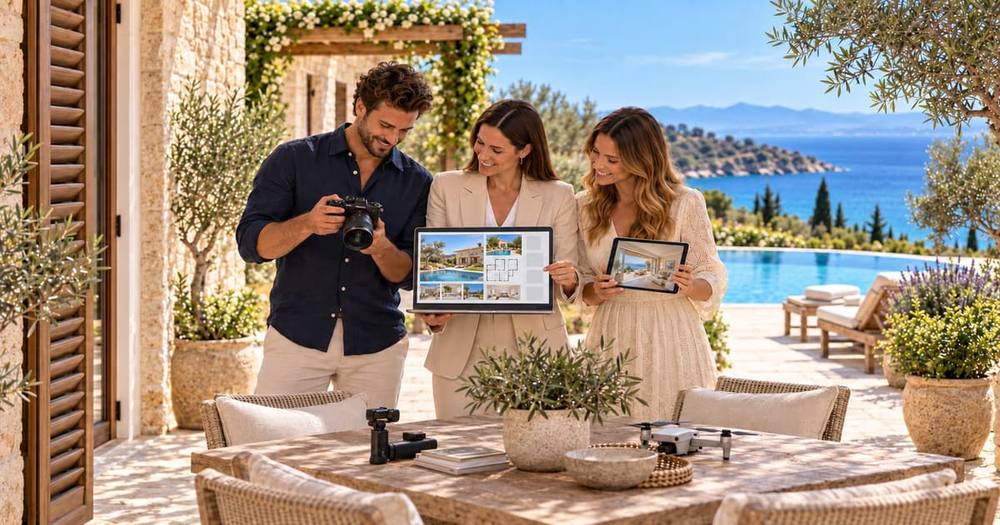
Chalkidiki Real Estate markets property in German, English, Greek, Russian and Turkish, with professional photography, floor plans, drone imagery and video as standard, distribution to the channels our buyers use, and direct outreach to a registered buyer database built over years.
This page is practical guidance. It is not a guarantee of a sale price or of a marketing period, both of which depend on the property, the price and the market at the time.

Would you like to know how your property would be presented and which buyer markets it would reach? Contact me by phone, WhatsApp or email.
- Mobile: +30 693 470 9163
- WhatsApp: +30 693 470 9163
- Email: hb@chalkidikirealestate.com
- Location: Chalkidiki Real Estate
- LinkedIn: Hans-Jürgen Bahner – Over 17k Followers
- Bestselling Author: Find My Books Here
Multilingual marketing for Chalkidiki property — German, English, Greek, Russian and Turkish, with professional photography, video and direct buyer outreach.
On this page
Select a topic to see how international buyers are actually reached and convinced.
Who Actually Buys in Chalkidiki
Marketing decisions follow from the buyer mix, so it is worth being specific about it.
German-speaking buyers from Germany, Austria and Switzerland are the largest foreign group. Balkan buyers — Serbian, Bulgarian, Romanian and North Macedonian — are numerous and within driving distance. Israeli and Cypriot buyers are active, British buyers persist, and buyers from further afield appear in the higher price bands and among those pursuing residence by investment. Greek domestic buyers, including families from Thessaloniki and the diaspora, remain a substantial part of the market and dominate the mainland and inland segments.
Their motivations differ. Most are buying a holiday home. A significant minority are buying for eventual relocation or retirement. A smaller group is buying for rental yield, and a smaller one again for residence purposes.
The practical consequence is that a Chalkidiki property has several potential buyer pools, and the marketing should identify which ones the specific property actually fits. A two-bedroom apartment five minutes from the beach in Kassandra is a holiday-home and rental product for several nationalities. A large inland stone house needing renovation is a narrow product for a particular kind of buyer, and it needs to be put in front of that buyer rather than advertised broadly.
How an International Buyer Searches
The typical path is long and mostly invisible to the seller. It begins months before any enquiry, with a family who have holidayed in Chalkidiki deciding they might buy. They browse portals in their own language, follow a few agencies, look at prices, and build a rough picture of what their budget buys.
At some point a specific property triggers an enquiry. Almost always it is triggered by photographs, viewed on a phone, filtered by price band and location. The description is read second, and only if the images passed.
Then comes verification: they ask for plans, the energy certificate, running costs, the legal status, and often a video walkthrough. This stage decides whether they book a flight, and it is where poorly documented properties are eliminated.
The trip follows — three or four days, six to ten properties, frequently across two peninsulas. Afterwards there is a period of reflection, sometimes weeks, often involving a second visit with a partner or a relative, before an offer.
Marketing has to work at every one of these stages, not only the first. A listing that generates enquiries but cannot answer the verification questions produces travel and no offers.
Photography That Converts
For a buyer six hundred kilometres away, the photographs are the property. They are the single highest-leverage element of the marketing, and the gap between amateur and professional images is measured in enquiries.
A complete set for a Chalkidiki property includes wide, correctly exposed interiors of every main room taken in daylight, with shutters open and lights on; exteriors from more than one angle; the terrace and the view as a buyer would see them sitting down; the garden and the plot to its boundaries; the sea, the beach and the route to it; and detail shots of the features that distinguish the property — a fireplace, a pergola, stonework, a well-designed kitchen.
Light matters more than equipment. Coastal exteriors and terraces photograph best in late afternoon; interiors need bright but indirect daylight. Midday sun flattens everything and blows out the sea.
What loses buyers: dark rooms, visible clutter, cars in the frame, unmade beds, closed shutters, distorted wide-angle shots that misrepresent room size, and — most damaging — too few photographs. A listing with five images reads as something the seller is hiding.
Preparation is part of photography, and it is covered on preparing your property for sale.
Drone, Video and Virtual Tours
Drone imagery answers the question every remote buyer asks first: where exactly is this? A single aerial frame showing the property, the settlement and the coastline communicates position, sea distance, surroundings and density better than a paragraph of description, and it pre-empts the disappointment of a buyer who imagined something different.
It also shows what is around the property, including what a buyer would otherwise discover on arrival: the neighbouring plot, the road, the hotel next door. Disclosure through imagery is far better than disclosure at a viewing.
Video walkthroughs give a sense of flow, scale and the relationship between rooms that stills cannot. A short, steady, well-lit walkthrough — entrance, main rooms, terrace, garden, view — is more useful than a long cinematic production.
Virtual tours have their place for higher-value properties and for buyers who cannot travel soon, though they rarely replace a live video viewing, where the buyer can ask questions and direct the camera.
Drone operation is regulated; use an operator who complies with the applicable rules, particularly near coastlines, settlements and any restricted airspace.
Floor Plans and Measurements
A floor plan with room dimensions is one of the most requested items among northern European buyers and one of the least common in Greek listings. Providing one is a genuine competitive advantage.
It answers questions photographs cannot: how the rooms relate to each other, whether the layout works for a family, where the bathrooms are, how big the bedrooms actually are, and whether a terrace is usable or decorative.
Measurements must be stated honestly and consistently. Greek practice distinguishes main areas from auxiliary spaces such as basements, storage rooms and semi-outdoor areas, and a listing that adds them together into one impressive figure will be corrected by the buyer’s lawyer at a moment when correction is expensive. State main area, auxiliary area and plot area separately, and make sure they match the deed and the technical file.
Where the property has been extended or altered, the plan should reflect the property as it lawfully stands. This is another reason to have the engineer’s file completed before publication rather than after.
Writing the Listing
The description is read by a buyer who has already liked the photographs and now wants to know whether the property is worth a flight. It should answer questions, not adjectives.
The facts that belong near the top: built area and plot area, number of bedrooms and bathrooms, year of construction, condition, energy class, heating and cooling, distance to the sea in walking minutes, distance to the nearest village and to the airport, parking, and whether the property is sold furnished.
Then the specifics that differentiate: orientation and afternoon sun, whether the view is protected, what the neighbouring plots permit, water and electricity supply, internet availability, pool and its running cost, garden and irrigation, and year-round accessibility.
Then the practical: annual running costs including ENFIA and municipal charges, shared charges for an apartment, the legal and technical status, and the availability of the document file.
What to avoid: vague superlatives, claims that a viewing will contradict, distances measured in a straight line, and silence on anything a buyer will notice immediately. Ambiguity produces either no enquiry or a sceptical one, and the energy certificate number must be quoted in any case.
Multilingual Listings
A listing published only in Greek addresses a fraction of the demand in Chalkidiki. A listing published in Greek and machine-translated English addresses more of it, badly.
Buyers read a poorly translated description as a signal about the agency and, by extension, about how the transaction will go. In a cross-border purchase where the buyer is already worried about language, law and distance, that signal matters more than it would at home.
Practical requirements: descriptions written, not translated word for word, in the languages of the actual buyer groups — German and English above all, with Greek for the domestic market and further languages according to the property; terminology that means something in the reader’s market, since “energy class”, “building permit” and “cadastre” each need an explanation a German or British buyer will recognise; and someone able to answer the follow-up enquiry in the same language, quickly.
That last point is where most multilingual marketing fails. A translated listing that produces a German enquiry answered three days later in approximate English has wasted the translation.
Portals and Syndication
Portals are where most buyers start, and presence on the right ones is necessary. It is not sufficient, and it is not free of pitfalls.
The mix that matters for Chalkidiki combines the main Greek portals, which reach domestic and diaspora buyers, and international portals oriented to buyers searching for property abroad, which reach the German-speaking and northern European market. Which specific portals justify their cost changes over time and is a question of measured enquiries rather than of reputation.
Two structural problems affect Chalkidiki listings. The first is duplication: the same property listed by several agencies at different prices, which inflates apparent supply and tells buyers the seller is uncertain. The second is syndication drift — aggregators copy listings, and outdated versions with old prices and old photographs persist long after the original is updated.
The remedies are one canonical set of images, one description, one price across every channel, and a periodic check of where the listing has been copied to.
Portals also strip context. A listing that reads well on the agency site becomes a truncated paragraph and eight images on an aggregator, which is another reason the first images and the first two lines carry so much weight.
The Agency Website and Search Visibility
The agency’s own site is where a serious buyer ends up after the portal, and it is where the transaction is actually won or lost. It is also the only channel where the presentation is fully controlled: full image set, floor plan, video, complete description, running costs, and a route into the guides that answer a foreign buyer’s underlying questions about buying in Greece at all.
Search visibility matters here more than sellers expect. A substantial share of buyers search in their own language for the location and property type rather than going through a portal — and a property listed on a site that ranks for those searches is seen by people the portals never reach.
Content is part of that: guides on buying property in Greece, on moving to Greece, and on the individual locations bring buyers into the site months before they enquire about a specific property, and they answer the questions that would otherwise stop a purchase.
For a seller the practical point is straightforward: ask where else the property will appear besides the portals, and what that channel actually reaches.
The Buyer Database and Direct Outreach
The fastest sales rarely come from a portal. They come from a buyer already registered with the agency, who has been looking for months, whose budget and criteria are known, and who receives the property before it is published anywhere.
A working database is not a mailing list. It records what each buyer is looking for — location, type, budget, plot, sea distance, condition, timing — and it is maintained, so that a new listing can be matched to the twenty people it actually suits rather than blasted to two thousand.
For distinctive properties, direct outreach outperforms advertising by a wide margin: a plot with unusual buildability, a commercial building, a property suitable for a specific investment purpose, or a house in a settlement where supply is scarce and there is a waiting list.
For sellers this is worth asking about explicitly when choosing an agency: how many registered buyers are looking in this area and price band, and how quickly will they hear about the property? The answer distinguishes an agency with a market position from one with a portal subscription.
Your local contact in Chalkidiki
Get in Touch with Hans-Jürgen Bahner
Would you like to know how your property would be presented and which buyer markets it would reach? Contact me by phone, WhatsApp or email.
- Mobile: +30 693 470 9163
- WhatsApp: +30 693 470 9163
- Email: hb@chalkidikirealestate.com
- Location: Chalkidiki Real Estate
- LinkedIn: Hans-Jürgen Bahner – Over 17k Followers
- Bestselling Author: Find My Books Here
Multilingual marketing for Chalkidiki property — German, English, Greek, Russian and Turkish, with professional photography, video and direct buyer outreach.
Social Media and Paid Advertising
Social channels work differently from portals. A portal reaches people who are actively searching; social advertising reaches people who are interested in the region but have not yet started a search, and it is therefore a way of expanding the buyer pool rather than competing within it.
What performs for Chalkidiki property is visual and specific: short video walkthroughs, aerial footage that establishes the location, and posts that answer a practical question a prospective buyer has — what a property of a given budget looks like in a given settlement, what the running costs are, how the purchase process works for a foreigner.
Paid campaigns can be targeted by country, language and interest, which suits a market whose buyers are concentrated in identifiable places. The discipline required is measurement: a campaign that produces impressions and no qualified enquiries is a cost, not a marketing channel.
What does not work is posting listings as static images to an audience with no connection to the region, and expecting reach to substitute for relevance.
For most properties, social advertising is a supplement to portals, the agency site and direct outreach — valuable for distinctive or higher-value properties, less so for standard stock where the buyers are already searching.
Remote Viewings
The live video viewing has become a standard step rather than a substitute for a visit, and it changes the economics of a cross-border sale.
Its function is filtering and confidence. A buyer in Munich who spends thirty minutes walking through the property by video, asking questions and directing the camera into the corners, either eliminates the property without travelling or arrives with genuine intent. Either outcome is better than a wasted trip.
Doing it well requires preparation: good light, a stable connection, a planned route through the property, the surroundings and the walk to the beach included, and honest coverage of the things a buyer would want to see — the technical spaces, the condition of the shared areas, the neighbouring plot.
Follow it immediately with the document pack. A buyer who has seen the property and then receives the plans, the energy certificate, the plot data and the running costs within hours is a buyer who books a flight.
For owners abroad this also solves an access problem, since the agent conducts the viewing and the owner does not need to be present or even awake.
The Buyer Information Pack
Serious buyers verify before they travel, and the speed and completeness of that verification is a competitive advantage that costs nothing to provide.
A useful pack contains the floor plan with dimensions, the energy performance certificate, the plot data and topographic plan for a house or land, a statement of the legal and technical position including the electronic building identity, the annual running costs — ENFIA, municipal charges, utilities, shared charges, pool and garden maintenance — what is included in the sale, and a summary of the purchase process and costs for a foreign buyer.
Two things follow from having it ready. First, the buyer’s questions are answered in one message rather than over three weeks of correspondence. Second, the seller looks organised, which materially affects how the negotiation proceeds — buyers make lower offers on properties that feel uncertain.
Prepare the pack during the document phase, not when the first enquiry arrives. See documents required to sell property in Greece.
Building Trust Across Borders
A foreign buyer purchasing in Greece is managing several anxieties at once: an unfamiliar legal system, a language they do not read, a property they will not see often, and stories from friends about transactions that went wrong. Marketing that ignores this loses buyers who liked the property.
What builds trust is unglamorous. Named people with contactable details rather than an anonymous form. Answers in the buyer’s language, quickly. Documents provided on request without hesitation. Honest disclosure of defects and of legal status. Explanation of the process — what a notary does, why the buyer needs a lawyer, what the costs are — before the buyer has to ask. Independent professionals recommended rather than imposed, so the buyer can appoint their own.
What destroys it: pressure, vagueness about the legal position, reluctance to provide documents, and a price that differs between channels.
For the seller this is not a soft consideration. A buyer who trusts the process completes at the agreed price; a buyer who does not either withdraws or uses their doubt as a negotiating instrument.
Presenting Price and Running Costs
Price presentation is part of marketing. Three points are worth attention.
Price bands. Buyers filter by ceiling, so a property priced marginally above a round threshold disappears from the searches of exactly the buyers who could afford it. Setting the asking price with the filters in mind costs nothing and expands the audience.
Total cost of acquisition. A foreign buyer must budget roughly five to seven per cent above the price for transfer tax, notary, registration and their own lawyer. Presenting this openly is better than letting them discover it, because a buyer who has budgeted correctly negotiates about the property rather than about the surprise.
Running costs. Northern European buyers ask about ENFIA, municipal charges, insurance, pool and garden maintenance, and caretaking during the months the property is empty. Being able to state real annual figures removes a common source of hesitation and distinguishes the listing from those that cannot.
Consistency across channels underpins all of it. Different prices on different portals are read as a seller in disarray, and the lowest one becomes the starting point for every negotiation.
German-Speaking Buyers
Buyers from Germany, Austria and Switzerland are the largest foreign group in Chalkidiki, and they behave consistently enough to plan for.
They research thoroughly and over long periods. They ask about legal status, permits and energy performance early, and they expect complete documentation before travelling. They are comparatively slow to decide and comparatively reliable once they do. They are sensitive to running costs and to the quality of construction, and they read a poor energy certificate as a renovation budget rather than as a deal-breaker.
What works: German-language descriptions written by someone who understands what a German buyer is actually asking; a complete document pack; floor plans with dimensions; honest disclosure, including of things that need work; a named contact who answers in German; and an explanation of the Greek process, since the differences from a German purchase — the role of the notary, the lawyer, the cadastre — are the source of most of their questions.
What fails: machine translation, vague measurements, reluctance to send documents, and pressure tactics, which this group reads as a warning sign rather than as urgency.
Balkan Buyers
Buyers from Serbia, Bulgaria, Romania and North Macedonia are a large and growing part of the Chalkidiki market, and they operate differently from the German-speaking group.
Chalkidiki is within driving distance, which changes everything: they visit frequently, often already know the region well from holidays, can view at short notice, and can return easily for a second visit. Decision cycles are correspondingly shorter, and a viewing arranged within two days of an enquiry is often possible.
They are strongly represented in the apartment and mid-range villa segments, particularly in Kassandra, and are often less concerned with energy performance and more with location, sea distance, the quality of the settlement and the practicality of the property for family summers.
What works: fast, direct communication; availability for viewings at short notice; clear information about the settlement and its infrastructure; and realistic pricing, because this group compares actively across the region.
For a seller, the operational implication is availability. A property that cannot be shown within a couple of days of an enquiry loses this buyer group disproportionately.
Israeli, British and Greek Buyers
Israeli buyers have been increasingly active in northern Greece, drawn by proximity, direct flights to Thessaloniki and the combination of coastline and price. They are frequently investment-minded, comfortable with a rental component, and quick when the numbers work.
British buyers remain present, though the practical picture has changed since the United Kingdom left the European Union: length-of-stay rules affect how a holiday home can be used, and this is a question they will raise. Being able to point to the residence framework — see our residence permit guide — removes an obstacle rather than creating one.
Greek domestic buyers, including families from Thessaloniki and the diaspora, are the backbone of the mainland and inland markets and a significant part of the coastal one. They are more sensitive to domestic financing conditions, more familiar with the legal process, and often more focused on the plot and the building’s substance than on presentation.
A property that suits several of these groups is liquid and can be priced firmly. One that suits only a narrow group needs targeted marketing and a longer horizon, and the pricing should reflect that from the start.
Investment and Residence-by-Investment Buyers
Two specialised buyer groups are worth understanding because they respond to different information.
Investment buyers price on income and effort. What they want is a documented rental history, realistic occupancy and rate data, a full picture of operating costs including management and taxation, and an assessment of how much work the property requires. Marketing that quotes a gross yield without deductions is dismissed immediately by anyone experienced. Where a property genuinely performs, the evidence is a powerful selling point — see our short-term rental management page for how the operating side works.
Residence-by-investment buyers need the property and the transaction to satisfy specific criteria, which narrows the field considerably but concentrates demand at particular value points. If your property is likely to qualify, that is a material marketing fact and should be established with a lawyer rather than asserted. Our Golden Visa guide explains the framework, and the criteria change, so the position must be confirmed at the time.
Both groups make decisions from documents rather than from atmosphere, which means the information pack matters more for them than the photography does.
Timing the Launch
Enquiries for Chalkidiki follow a seasonal curve: building from late winter as buyers plan spring and summer travel, peaking through the visiting months, and falling away in late autumn. Sales are agreed year-round, but the number of buyers physically able to view is concentrated.
Because a listing has its largest audience in its first three to six weeks, launch timing matters. A property ready to photograph and show in March gets its high-attention window in front of the whole season. The same property launched in November with hurried photographs spends that window in front of the smallest audience of the year, and by spring it is no longer new.
For a property that will not be ready until late autumn, the honest options are to launch with complete, excellent material and accept a slower start, or to prepare thoroughly over winter and launch in early spring. What does not work is a rushed launch followed by re-photographing in April, because the original images are already circulating.
Owners who can choose their timing hold a genuine advantage and should use it deliberately.
Measuring What Works
Marketing without measurement becomes an article of faith, and sellers should expect numbers rather than reassurance.
The metrics that mean something are listing views by channel, enquiries by channel and by country, the conversion from enquiry to viewing, the number of viewings, and — most useful of all — what the objections were after a viewing. A property with many views and few enquiries usually has a price or photography problem. Many enquiries and few viewings suggests the verification stage is failing: missing documents, unanswered questions, slow responses. Many viewings and no offers points at price or at a defect that shows in person.
This is also how a price review should be conducted. After a defined window of active marketing — typically eight to twelve weeks — the decision to adjust should rest on that evidence rather than on impatience.
Ask any agency you instruct how they report, how often, and what they will show you. A monthly written report with these figures is a reasonable expectation.
Common Mistakes
- Five dark photographs taken on a phone. The listing is eliminated before the description is read.
- Marketing only in Greek. A fraction of the actual demand is addressed.
- Machine-translated descriptions. Read as a signal about the whole transaction.
- Different prices on different portals. The lowest becomes the negotiating baseline.
- No floor plan. One of the most requested items among northern European buyers.
- Distances in a straight line. Corrected at the viewing, at the cost of credibility.
- Slow replies to enquiries. Buyers planning a trip move on within days.
- No document pack. Verification stalls and the flight is never booked.
- Hiding a defect that is visible on arrival. Trust is worth more than the defect.
- Launching before the property is ready. The images last the entire marketing period.
How Chalkidiki Real Estate Can Help
Our marketing is built around the fact that most of our buyers are not in Greece. Every instruction includes professional photography, a floor plan with dimensions, drone imagery and a walkthrough video, produced once the property is genuinely ready rather than as it is found.
Listings are written — not translated — in the languages our buyers use, and enquiries are answered in the same language by a named person: our team works in German, English, Greek, Russian and Turkish. Distribution combines our own site, the Greek and international portals that measurably produce enquiries for this region, targeted advertising in the source markets, and direct outreach to our registered buyer database, which for many properties produces the fastest result.
We prepare the buyer information pack during the document phase, run live video viewings for buyers who cannot travel immediately, and report to you on views, enquiries by country, viewings and the objections that came back — so that any price discussion is based on evidence.
And we keep the property in the condition it was photographed in for the duration of the marketing, which for an owner abroad is often the difference between a viewing that converts and one that disappoints.
Frequently Asked Questions About Marketing to International Buyers
Which languages should my listing be in?
Is professional photography worth the cost?
Do I need drone footage?
Should the property be on as many portals as possible?
How quickly should enquiries be answered?
What is a buyer information pack?
Do video viewings actually lead to sales?
Should I disclose defects in the listing?
When is the best time to launch?
How do I know whether the marketing is working?
Does social media advertising help?
What if my property only suits a narrow buyer group?
Official Sources and Important Notice
Advertising requirements — including the obligation to quote the energy performance certificate — and the rules governing drone operation and real estate agency practice are set by Greek law and change over time. Confirm the current position before publishing.
- gov.gr – Greek government digital services portal
- Bank of Greece – real estate market statistics
- Hellenic Statistical Authority – official statistics
Professional notice: This guide provides general information about marketing property to international buyers and is not a guarantee of any sale price or marketing period, nor legal advice on advertising obligations.
Would you like to know how your property would be presented and which buyer markets it would reach? Contact me by phone, WhatsApp or email.
- Mobile: +30 693 470 9163
- WhatsApp: +30 693 470 9163
- Email: hb@chalkidikirealestate.com
- Location: Chalkidiki Real Estate
- LinkedIn: Hans-Jürgen Bahner – Over 17k Followers
- Bestselling Author: Find My Books Here
Multilingual marketing for Chalkidiki property — German, English, Greek, Russian and Turkish, with professional photography, video and direct buyer outreach.
Continue the Sell With Us Cluster
Presentation is one part of a successful sale. Continue with preparation, pricing, the document file and completion.