
Moving to Greece – Complete Relocation Guide
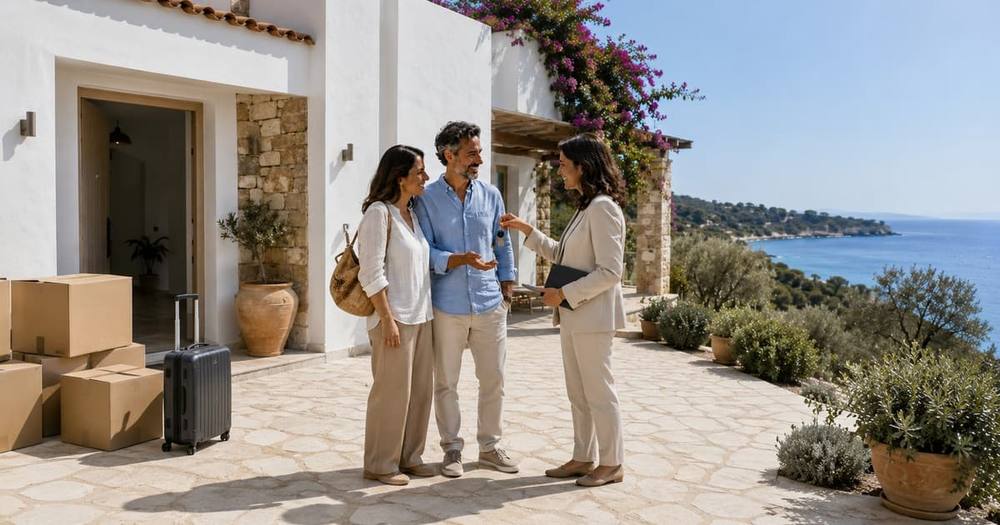
Moving to Greece is more than changing your address. It is the beginning of a new way of living: Mediterranean weather, more time outdoors, fresh food, strong community traditions, beautiful coastlines, and the opportunity to make a home in one of Europe’s most distinctive countries. For many international buyers, Greece also offers an attractive combination of lifestyle, property ownership, remote working possibilities, retirement options, and long-term investment potential.
However, a successful move requires more than finding a beautiful villa. Residence rights, tax registration, healthcare, insurance, banking, housing, utilities, transport, education, documentation, and the practical setup of the property all need attention. Some procedures are connected, but they are not interchangeable. Owning a house does not automatically create residence rights. A residence document does not by itself determine tax residence. An AFM is not the same as an AMKA. Understanding these distinctions prevents expensive misunderstandings.
This comprehensive Moving to Greece guide is written for EU citizens, non-EU citizens, property buyers, retirees, remote professionals, families, and people considering a move to Chalkidiki. It explains the main decisions in a logical order, highlights where requirements differ, and shows how Chalkidiki Real Estate can coordinate the property and relocation aspects of your journey.
Our position is simple: we are more than a real estate agent. We help international clients connect property search, purchase, renovation, furnishing, utility registration, maintenance, and long-term management. Where legal, immigration, tax, accounting, insurance, engineering, or regulated professional advice is required, we introduce and coordinate appropriately qualified specialists. This gives clients one trusted local starting point without confusing real-estate support with professional legal authority.
Rules, fees, documentary requirements, and administrative practices can change. They can also differ according to nationality, family status, income source, municipality, and the responsible authority. This guide provides a practical overview, not individual legal or tax advice. Before acting, verify your current requirements with the relevant Greek authority and qualified professional.

Are you planning to move to Greece, buy a property or establish your new life in Chalkidiki? Contact me personally to discuss your relocation and property requirements.
- Mobile: +30 693 470 9163
- WhatsApp: +30 693 470 9163
- Email: hb@chalkidikirealestate.com
- Location: Chalkidiki Real Estate
- LinkedIn: Hans-Jürgen Bahner – Over 17k Followers
- Bestselling Author: Find My Books Here
Personal support for international property buyers and people moving to Chalkidiki and Greece.
On this page
Select a topic to plan your move, property purchase, and new life in Greece.
Why Move to Greece?
Greece attracts people for reasons that reach far beyond summer holidays. The climate supports an outdoor lifestyle, regional food remains closely connected to local production, and the rhythm of daily life can feel more personal than in many large northern European cities. Mountains, islands, beaches, historic towns, and major urban centers offer very different living environments within one country.
For property buyers, Greece presents a wide range of possibilities: village homes, city apartments, holiday properties, modern villas, renovation projects, land, and income-producing real estate. Prices vary significantly by region, exact location, condition, access, sea view, planning status, and tourism demand. Buyers should evaluate the individual property rather than relying on national averages or promotional claims.
Connectivity has also improved. Thessaloniki and Athens provide international airports, universities, hospitals, business networks, and cultural life. Fiber and mobile coverage are expanding, while Starlink can offer an additional option in suitable locations. This makes Greece relevant not only to retirees, but also to entrepreneurs, consultants, remote employees, and families seeking a longer-term base.
The advantages do not remove practical challenges. Administrative processes may require Greek-language documents, appointments, certified translations, tax credentials, or local representatives. Seasonal areas feel different in winter, and a property that functions well in August may need additional heating, insulation, drainage, or maintenance for year-round use. A successful move is based on realistic preparation, not only enthusiasm.
Planning Before You Move to Greece
Start by defining what “moving” means for you. Will Greece become your permanent home, your principal tax residence, a seasonal base, a retirement destination, or a place where you spend several months each year? Will you work locally, operate a Greek business, continue foreign employment, live from pension or investment income, or combine several sources? These answers affect residence, tax, insurance, banking, and property decisions.
Create a personal timeline that begins before arrival. Passports, civil-status documents, income evidence, pension records, employment information, insurance certificates, driving documents, school records, pet documentation, and powers of attorney may be easier to obtain in your current country. Some foreign documents may require legalization or an apostille and certified translation. A lawyer should confirm what is required for your specific procedure.
Do not terminate every arrangement in your home country before your Greek plan is secure. Healthcare coverage, tax residence, vehicle registration, banking, mail, and insurance can have transition periods. Coordinate decisions across both countries, particularly where double-taxation agreements, social-security coordination, pension coverage, employment, or company ownership are involved.
A relocation budget should include temporary accommodation, travel, deposits, legal and accounting support, translations, property expenses, furniture, utilities, transport, insurance, and contingency. If you are buying or renovating, keep the relocation reserve separate from the construction budget. This protects your move if completion or delivery takes longer than expected.
Moving to Greece as an EU Citizen
EU citizens benefit from freedom of movement. As a general EU rule, you may enter Greece with a valid national identity card or passport and stay for up to three months without applying for a residence document. For a stay beyond three months, your right to reside depends on your status, for example as an employee, self-employed person, student, jobseeker, pensioner, or economically inactive person with sufficient resources and comprehensive health insurance.
Greece may require EU citizens staying longer than three months to complete residence registration with the competent authority and obtain a registration certificate. This is not the same as a conventional immigration residence permit issued to many non-EU nationals. The supporting evidence depends on the category under which you reside. An employee may need employment confirmation; a self-employed person needs evidence of activity; students and economically inactive persons generally need suitable insurance and financial-resource evidence.
EU rules also protect qualifying family members, but procedures differ when a family member is not an EU citizen. A non-EU spouse or dependent may need an entry visa depending on nationality and must generally apply for the appropriate residence card within the applicable deadline. Civil-status evidence and proof of the family relationship may require formal authentication and translation.
After five years of continuous legal residence under the relevant conditions, EU citizens generally acquire a right of permanent residence under EU law. Continuity and permitted absences have specific rules. Because personal circumstances can change—employment ending, family status changing, or long absences occurring—obtain current advice instead of assuming that the initial registration resolves every future question.
Moving to Greece as a Non-EU Citizen
Non-EU citizens normally need an immigration route appropriate to the purpose and duration of their stay. Depending on nationality and circumstances, this may involve obtaining a national visa before entry and applying for a residence permit in Greece. Common categories include employment, family reunification, studies, financially independent residence, remote work, business or investment activity, and the Greek Golden Visa.
The correct route must be identified before making irreversible plans. A tourist or short-stay entitlement does not normally authorize permanent residence or local employment. Buying a property does not automatically create residence rights. A real-estate purchase may support a Golden Visa only when the investment and property meet the current statutory requirements and the applicant completes the correct legal process.
Documentation can include passports, entry visas, criminal-record certificates, civil-status documents, insurance, income or employment evidence, accommodation, investment evidence, and biometrics. The exact list and sequence depend on the permit. Documents issued abroad may need legalization, apostille, or certified translation. Processing times and temporary proof of application vary.
Immigration rules are high-stakes and change over time. We therefore connect clients with qualified immigration lawyers rather than presenting one general route as suitable for everyone. Property search can run alongside legal preparation, but the purchase schedule, source-of-funds documents, ownership structure, and intended residence pathway should be coordinated early.
Residence Rights and Tax Residence Are Not the Same
One of the most important distinctions when moving to Greece is the difference between immigration or residence status and tax residence. A residence document concerns your legal right to live in Greece. Tax residence determines which country generally has the right to tax your worldwide income, subject to domestic legislation and applicable double-taxation agreements. One status does not automatically settle the other.
The Greek tax authority explains that an individual may be considered a Greek tax resident when Greece is the permanent or principal residence, habitual abode, or center of vital interests—that is, where personal and economic relations are centered. Presence in Greece exceeding 183 cumulative days during a twelve-month period can also create Greek tax residence from the first day of presence, subject to stated exceptions and treaty analysis.
Counting days alone is therefore not enough. Family home, employment, business interests, property availability, habitual living pattern, and treaty tie-breaker rules may matter. Someone spending time between Greece and another country should obtain tailored cross-border advice before filing returns, transferring a business, drawing pension income, or changing official address.
Keep evidence of travel dates, housing, work, insurance, and tax filings. Discuss the intended move with advisors in both countries. Tax-residence changes can affect income reporting, capital gains, dividends, pensions, property, inheritance planning, companies, social insurance, and reporting obligations. This is an area where early advice is far less expensive than correcting inconsistent filings later.
Important: a Greek residence certificate, an AFM, property ownership, and Greek tax residence are four different concepts. They may interact, but none should be treated as automatic proof of all the others.
Obtaining a Greek Tax Number (AFM)
The AFM is the Greek tax identification number. It is central to many financial and administrative activities, including purchasing property, dealing with tax authorities, opening or operating certain accounts, entering contracts, and completing transactions that must be reported in Greece. Foreign citizens can require an AFM even when they are not Greek tax residents.
Official digital services allow a natural person to request an AFM electronically and complete identification by video appointment or in person at a tax office, depending on the available procedure and individual situation. An authorized representative may be able to act under appropriate authority. Required information can include identity, birth details, nationality, family status, contact details, related persons, and supporting documents.
Receiving an AFM is only the beginning. You may also need access credentials for Greek tax services, correctly recorded contact and address information, and—depending on residence—an appointed tax representative. Your accountant should confirm what must be registered, which tax office or digital process applies, and what filing obligations follow from property ownership or other activity.
Names must be consistent across passports, tax records, bank records, contracts, and utilities. Differences in transliteration, middle names, married names, or document numbers can cause delays. Check every official entry carefully when it is created and retain the confirmation securely.
Healthcare, Health Insurance and AMKA
Your healthcare plan depends on nationality, employment, pension status, insurance history, residence category, and whether European social-security coordination applies. Do not assume that a European Health Insurance Card is a complete solution for permanent relocation. It is primarily designed for medically necessary state healthcare during temporary stays under the applicable rules.
EU employees, posted workers, pensioners, and family members may have different routes. In some cases, an S1 form from the competent insurance institution can support registration for healthcare in Greece. People working and insured in Greece generally enter the Greek social-insurance framework through their employment or self-employment. Private insurance may be required for some residence categories or used to supplement public coverage.
AMKA is the Greek social-security registration number. The Ministry of Labour states that it is mandatory for people who work, are insured, or intend to work in Greece, and that issuance is handled through Citizens’ Service Centres (KEP) or e-EFKA branches with the required documents. Eligibility and supporting evidence should be checked for the individual applicant.
Before moving, obtain written confirmation of how existing treatment, prescriptions, chronic conditions, planned care, maternity coverage, and family members will be handled. Bring medical summaries and medication information where useful, but protect sensitive records. Identify local doctors, pharmacies, emergency access, and the nearest suitable hospital, especially if moving to a rural or seasonal area.
Opening and Using a Greek Bank Account
A Greek bank account can simplify property purchases, utilities, taxes, local direct debits, salary payments, and day-to-day transactions. Whether it is legally essential depends on the activity and provider, but it is often operationally valuable. Banks apply identity, tax-residence, source-of-funds, and anti-money-laundering checks.
Documentation may include a passport or identity card, AFM, address evidence, tax-residence information, employment or income evidence, phone number, email, and supporting translations. Requirements vary between banks and can change. Some onboarding steps may be digital, while foreign applicants may still need an appointment or additional verification.
For a property purchase, prepare source-of-funds evidence well in advance. International transfers, currency conversion, transfer limits, bank compliance reviews, and timing should be coordinated with the lawyer and notary. Never leave a purchase payment until the final day without confirming that the receiving structure and documentation are accepted.
Set up secure online banking, alerts, and recovery methods. Keep your Greek phone number and contact register updated when required. Protect credentials and never send one-time codes to a supposed agent. A legitimate advisor may help you understand a process, but should not need uncontrolled access to your banking login.
Should You Rent or Buy When Moving to Greece?
Buying immediately provides stability and may secure a property you already know is right. Renting first provides time to experience winter, traffic, local services, wind, humidity, distance from town, and the rhythm of a neighborhood outside the holiday season. The correct choice depends on confidence, availability, family needs, and the quality of your due diligence.
A trial period can be particularly valuable when choosing between city and coastal living. A beachfront summer location may be quiet in winter; a village may offer community but require a car; a remote villa may provide privacy but need careful maintenance and backup connectivity. Daily life is shaped by practical distance to healthcare, schools, supermarkets, airports, and work—not only the view.
If renting, insist on a clear written agreement and confirmation that the arrangement can be registered and used for the administrative purpose you require. Understand deposits, utilities, maintenance, furnished inventory, pets, termination, and seasonal restrictions. Short-term tourist accommodation may not provide the documentation or stability needed for relocation procedures.
If buying, do not let relocation urgency weaken legal and technical checks. Independent lawyer and engineer review, title and planning checks, tax preparation, ownership-cost analysis, and written understanding of the property’s condition remain essential. A beautiful home with unresolved documentation or water problems can delay the entire move.
Finding the Right Property for Your New Life
A relocation property should be evaluated differently from a two-week holiday rental. Consider heating, insulation, ventilation, storage, laundry, parking, internet, security, drainage, year-round water supply, access in poor weather, and maintenance when you are away. Large outdoor areas and pools can be wonderful, but they create recurring work and cost.
Define your essential criteria before viewing. These may include permanent residence, rental potential, accessibility, number of bedrooms, office space, sea proximity, village access, privacy, garden, pool, renovation tolerance, airport distance, and budget including transaction and improvement costs. Separate genuine requirements from preferences that can be changed later.
Visit the area at different times if possible. Listen for road, business, or neighboring noise. Check sun orientation, wind exposure, mobile signal, parking, slopes, and the condition of surrounding properties. Ask how the area functions in winter. A local inspection cannot guarantee the future, but it can replace assumptions with better evidence.
Chalkidiki Real Estate helps international buyers connect lifestyle criteria with property reality. We can identify suitable opportunities, arrange viewings, explain locations, coordinate professional checks, and help estimate the work required to make a property ready for full-time or seasonal living.
The Property-Buying Process in Greece
A typical purchase involves an AFM, legal representation, technical review, tax and notarial steps, proof of funds, contract preparation, signing, and registration. The exact sequence depends on the property, buyer, financing, ownership structure, and findings. Independent professional advice protects the buyer and should begin before paying a significant reservation amount.
The lawyer investigates legal ownership, encumbrances, claims, contract terms, and documentation within the agreed mandate. The engineer assesses planning and technical documentation, identifies declared and actual property characteristics, and advises on relevant compliance matters. The notary prepares and executes the formal deed and verifies the requirements within the notarial process.
Buyers should understand the complete acquisition budget: agreed price, taxes, professional fees, registration costs, agency commission, banking and transfer costs, translations, surveys, and immediate repairs or setup. Current taxes and fees should be calculated by the relevant professionals for the specific transaction rather than taken from a generic percentage online.
After signing, ownership registration and handover actions still matter. Keys, meter readings, insurance, utilities, communal charges, manuals, equipment, taxes, and maintenance should be organized. If the property will remain empty or be renovated, arrange local inspection and access control immediately.
Renovation, Furnishing and Preparing the Property
Many relocation buyers find a well-located property that does not yet meet modern expectations. Renovation can improve layout, safety, energy performance, bathrooms, kitchens, heating, cooling, windows, waterproofing, lighting, and outdoor living. Begin with assessment and design, not finishes. Hidden systems and moisture must be addressed before decorative work.
Where approvals, engineering, licensed installations, or certifications are required, appropriately qualified professionals must lead those tasks. Quotations should use a clear scope, and contingency should be retained for existing-building discoveries. Imported items, custom kitchens, windows, and specialist equipment may have long lead times.
Furnishing for permanent living differs from furnishing for sale photography. Plan storage, work space, winter textiles, equipment access, guest needs, and maintenance. If the property may also be rented, distinguish owner storage and select durable, replaceable items. Do not fill the home before testing how rooms are used.
We coordinate renovation, remodeling, technical services, windows, doors, outdoor works, utilities, Starlink, smart-home systems, cleaning, furniture delivery, garden care, and final setup. Owners abroad receive one local coordination point while licensed professionals remain responsible for regulated work.
Electricity, Water, Internet and Administrative Setup
Utility transfer is a practical priority after purchase or before moving into a rental. Electricity, water, communal charges, internet, waste arrangements, gas where applicable, and local services may involve different providers and documents. Meter identifiers, readings, ownership or tenancy evidence, AFM, contact information, and payment method can be required.
Do not assume that an active supply is correctly registered or debt-free for your purposes. The lawyer, accountant, property manager, or provider should confirm the appropriate process. Photograph meter readings at handover, retain contracts, and note customer-service contacts. Check capacity where new air conditioning, heat pumps, pool equipment, or electric-vehicle charging is planned.
Internet availability must be verified at the exact address. A nearby fiber cabinet does not guarantee service to a particular house. Request provider checks and consider mobile or satellite alternatives. For remote work, use backup power and connectivity where interruption would create business risk.
Digital administration in Greece often relies on AFM-linked credentials, verified contact information, mobile access, and electronic documents. The National Contact Register is used for contact details in public online transactions. Set up access carefully, keep phone and email current, and store recovery information securely.
Working, Freelancing or Starting a Business in Greece
EU citizens may work or become self-employed subject to the normal registration, tax, professional, and social-insurance requirements. Non-EU citizens require a status that authorizes the intended activity. Immigration permission, tax registration, company formation, invoicing, VAT, employment law, and social insurance are separate areas that need coordinated advice.
Before transferring an existing business or opening a Greek one, discuss structure with a Greek accountant and lawyer. Company type, management location, permanent establishment, VAT, payroll, profit distribution, accounting obligations, and tax residence of the owner can affect the result. A foreign company does not remain outside Greek taxation merely because it was incorporated elsewhere.
Freelancers need clarity on commencement of activity, professional codes, invoices, deductible expenses, advance tax, social-security contributions, VAT status, and reporting. Some professions require recognition, membership, or licensing. Obtain a written estimate of recurring compliance and not only formation cost.
Employment arrangements also need review when a foreign employer allows work from Greece. Payroll withholding, employer registration, social security, labor law, data security, and corporate tax presence may be relevant. A casual remote-work agreement is not a substitute for cross-border employment advice.
Your local contact in Chalkidiki
Get in Touch with Hans-Jürgen Bahner
Are you planning to move to Greece, buy a property or establish your new life in Chalkidiki? Contact me personally to discuss your relocation and property requirements.
- Mobile: +30 693 470 9163
- WhatsApp: +30 693 470 9163
- Email: hb@chalkidikirealestate.com
- Location: Chalkidiki Real Estate
- LinkedIn: Hans-Jürgen Bahner – Over 17k Followers
- Bestselling Author: Find My Books Here
Personal support for international property buyers and people moving to Chalkidiki and Greece.
Remote Workers and Digital Nomads
Greece can be an excellent remote-work base, but immigration, tax, employment, and connectivity must align. EU citizens use freedom-of-movement rules and the relevant residence conditions. Eligible non-EU remote workers may consider the current Digital Nomad route, provided their work, clients or employer, income, insurance, and other requirements fit the applicable law.
The immigration label does not determine tax treatment. A person may become tax resident through time spent, center of vital interests, or other criteria. Employment for a foreign company can create obligations for both worker and employer. Obtain specialist advice before committing to a long stay or advertising that you work from Greece.
Choose a property with a suitable workspace, controllable light, heating and cooling, acoustic separation, reliable electricity, and verified internet. Coastal homes can experience seasonal power or network interruptions. A secondary mobile connection, uninterruptible power supply, surge protection, and secure router configuration can protect continuity.
Consider the social side of remote work. Thessaloniki offers coworking, professional networks, and urban services. Chalkidiki offers quiet, space, and nature, but winter isolation may not suit everyone. A mixed routine or location near a year-round town can provide a better balance.
Retiring in Greece
Greece is attractive to retirees because of climate, outdoor living, food, community, and access to coastal property. EU pensioners can exercise residence rights when they meet applicable conditions, including sufficient resources and comprehensive health coverage. Non-EU retirees need a suitable immigration category, which may include a financially independent route if current requirements are satisfied.
Healthcare planning comes first. Determine how public coverage, S1 registration where applicable, private insurance, prescriptions, and ongoing treatment will work. Select a location with realistic access to pharmacies, doctors, laboratories, and hospitals. A remote sea-view property may not be the best choice if frequent specialist care is required.
Pension taxation requires individualized advice. Tax residence, pension type, source country, double-taxation agreement, special regimes, investment income, property, inheritance, and estate planning can all matter. Do not make the move solely on the basis of a headline tax rate without eligibility and long-term analysis.
Plan the property for aging well. Step-free access, safe bathrooms, manageable gardens, heating, shade, storage, security, and room for visitors can be more valuable than maximum size. Ongoing property management is useful when owners travel or spend part of the year elsewhere.
Moving to Greece with Children and Family
Families should align housing, school, work, healthcare, language, and travel before choosing a location. Public, private, international, and bilingual options vary significantly by area. Thessaloniki provides more school choice than rural Chalkidiki, so daily transport may become a defining factor.
Contact schools early and request current admission requirements. Records may include birth certificates, identity documents, previous school reports, vaccination or health information, residence evidence, and translations. Placement and curriculum decisions should be discussed directly with the school and competent education authorities.
Children often adapt through language faster than adults, but transition still deserves support. Sports clubs, local activities, and consistent routines help integration. Parents should consider the social difference between a lively summer destination and winter community life.
Family residence procedures differ according to nationality and relationship. Non-EU family members of EU citizens may have rights under EU law but still need the correct card and documentation. Other non-EU families follow the relevant national permit route. Obtain professional guidance for custody, consent, civil-status, and dependent-family questions.
Driving Licences, Cars and Transport
A car is highly useful in much of Chalkidiki. Public transport connects main areas, but schedules may be seasonal and many beaches, villages, medical appointments, and properties are easier to reach by car. Consider parking, road access, steep driveways, and winter conditions when selecting a home.
An EU driving licence is generally recognized across the EU, and moving to another EU country does not normally require immediate exchange. Exchange can become necessary in circumstances such as loss, theft, damage, certain indefinite-validity licences, or renewal under the applicable rules. Non-EU licences are governed by national recognition and exchange arrangements and must be checked individually.
Importing or permanently keeping a foreign vehicle in Greece can involve customs, tax residence, registration, insurance, inspection, and time-limit questions. Do not rely on informal assumptions based on foreign plates. Ask a customs specialist and insurer to review your actual residence and vehicle situation before moving the car.
Compare import cost and complexity with buying locally. A Greek vehicle requires registration, insurance, roadworthiness compliance, and tax administration. For occasional use, rental or car-sharing may be more efficient until your residence situation is established.
Moving to Greece with Pets
Pet movement rules depend on origin country, species, identification, vaccination, health documents, and whether the movement is commercial or non-commercial. For common household pets traveling within the EU, microchip, valid rabies vaccination, and an EU pet passport are normally central requirements. Travel from outside the EU may require an animal-health certificate, approved entry point, or additional conditions.
Check official EU and Greek veterinary guidance well before travel, especially for young animals, multiple pets, unusual species, or countries with additional rabies requirements. Airlines and ferries have their own booking, carrier, size, and seasonal rules. Hot-weather travel should be planned carefully.
When selecting a home, consider secure boundaries, shade, nearby walking areas, garden plants, neighbors, and access to a veterinarian. Holiday regions may have different service availability in winter. Identify an emergency clinic and keep vaccination and microchip records accessible.
Rental agreements and condominium rules may address animals. Even where general pet rights exist, damage, noise, common areas, and welfare responsibilities remain. Clarify expectations before signing.
Daily Life, Language and Integration
You can manage many initial tasks in English, particularly in tourism and professional services, but learning Greek improves independence and trust. It helps with neighbors, tradespeople, local offices, medical situations, signs, and everyday shopping. Even basic language effort changes the quality of integration.
Administrative culture may feel relationship-based and document-heavy. Bring organized copies, confirm appointments, ask exactly which office is competent, and expect that one procedure may require information from another. Requirements can vary in practice, so polite persistence and local support are valuable.
Daily schedules differ by season and region. Summer can be busy, hot, and tourism-focused; winter is quieter and reveals the permanent community. Shops, restaurants, flights, and services may reduce hours in holiday zones. Spend time locally outside peak season before committing to full-time coastal life.
Integration works best when newcomers participate rather than recreate life entirely inside an expatriate circle. Support local businesses, attend community events, respect quiet hours and shared spaces, and learn local waste, water, fire-safety, and animal-welfare practices.
Costs and Budgeting for a Move to Greece
Relocation cost is personal. Housing, energy, healthcare, schooling, transport, food, insurance, travel, and entertainment vary by household and location. Tourist areas can have seasonal pricing, while permanent housing supply may be limited. Build a budget from actual quotations and current local listings rather than broad “cost of living” tables.
Property owners should include annual property taxes, insurance, communal expenses, electricity, water, internet, garden and pool care, security, repairs, accounting, and periods of vacancy. Coastal homes need ongoing exterior and equipment maintenance. Larger plots and pools create recurring obligations even when the owner is absent.
Initial setup costs can be significant: temporary accommodation, deposits, professional fees, translations, furniture, appliances, utility connections, vehicle decisions, travel, and contingency. Renovation projects should have their own detailed budget and reserve.
Currency risk matters for people whose income or assets are outside the euro. Transfer timing, bank fees, pension conversion, and international tax can change effective cost. A sustainable plan uses conservative assumptions and retains liquidity after the property purchase.
Moving to Chalkidiki
Chalkidiki combines clear sea, beaches, forests, villages, tourism, and proximity to Thessaloniki. Kassandra offers established resorts, services, nightlife, and strong holiday demand. Sithonia is known for dramatic coastline, natural landscapes, and quieter destinations. Central and northern areas provide year-round towns, agriculture, and practical access, while the Athos peninsula has its own distinct character and restrictions.
Location choice should reflect how often you need Thessaloniki, the airport, hospitals, schools, work, and year-round shopping. Traffic can be heavy during summer weekends. A property that appears close on a map may involve slower roads or seasonal congestion. Visit the exact route and test everyday journeys.
Coastal exposure influences construction. Salt, wind, sun, humidity, rain, drainage, and long vacancy affect façades, metal, windows, air-conditioning equipment, roofs, gardens, pools, and electronics. A year-round residence also needs appropriate winter heating and moisture management.
Chalkidiki is particularly suited to buyers who want personal use combined with managed rental potential. However, income depends on property quality, location, licensing, season, management, pricing, and demand. We can connect purchase decisions with renovation, Airbnb setup, garden and pool care, maintenance, check-in, cleaning, and owner reporting.
Your First 90 Days in Greece
During the first weeks, secure accommodation, local communication, healthcare access, banking, and professional contacts. Confirm your residence route and deadlines. Obtain or organize AFM and tax credentials where required. Record arrival dates and retain travel evidence for residence and tax discussions.
Complete property handover carefully. Photograph meters, transfer utilities, arrange insurance, test locks and alarms, identify isolation valves and electrical panels, and establish emergency contacts. If the house will be empty before you fully relocate, arrange inspections and key holding.
Build a document folder containing identity records, residence applications, AFM, tax details, insurance, AMKA or social-security information, property documents, utility contracts, bank information, vehicle records, and translations. Keep encrypted digital copies and secure originals.
Do not attempt every registration in the wrong order. A lawyer, accountant, immigration specialist, and relocation coordinator can map dependencies. The aim is not simply to collect numbers and certificates, but to create a consistent legal, tax, healthcare, and property setup.
Common Mistakes When Moving to Greece
- Confusing property ownership with residence rights. Buying a home does not automatically authorize a non-EU citizen to live in Greece.
- Confusing residence registration with tax residence. Immigration status and worldwide-income taxation follow different rules.
- Waiting until after arrival to collect foreign documents. Apostilles, certificates, and translations may take time.
- Choosing a home only from a summer visit. Winter services, humidity, heating, and community life can be very different.
- Underestimating property maintenance. Coastal buildings, pools, gardens, and vacant homes need regular attention.
- Working remotely without cross-border advice. Employer, payroll, social-security, and tax obligations may arise.
- Importing a car based on informal advice. Customs, registration, insurance, and residence status require specific review.
- Using inconsistent names across records. Transliteration and document differences can block banking and administration.
- Spending the full budget on purchase price. Taxes, fees, repairs, furniture, setup, and contingency remain.
- Assuming spoken agreements are enough. Scope, price, authority, and deadlines should be documented.
How Chalkidiki Real Estate Can Help
Chalkidiki Real Estate supports international clients before, during, and after their move. We begin with your lifestyle, property, and investment objectives and help translate them into a realistic local plan. Our core role is real estate and property coordination, supported by a network of relevant professionals.
We can help with property search, viewings, buyer coordination, technical and legal appointments, renovation, construction management, utility registration, internet, smart-home systems, furniture delivery, cleaning, garden and pool care, key holding, inspections, Airbnb management, maintenance, and local contractor communication.
For immigration, tax, legal, accounting, insurance, engineering, notarial, or other regulated matters, we connect clients with qualified specialists. This separation protects the client: each professional remains responsible for advice and documents within their competence, while we coordinate the practical property journey.
Our goal is long-term support. After you receive the keys, questions continue. A storm can reveal a leak, utilities need monitoring, a garden requires seasonal care, or you may decide to rent the home. Having one local partner who already knows the property creates continuity and confidence.
Frequently Asked Questions About Moving to Greece
Can an EU citizen move to Greece without a visa?
Can I live in Greece simply because I buy a property?
Does staying more than 183 days automatically make me a Greek tax resident?
What is the difference between AFM and AMKA?
Do I need a Greek bank account?
Can I work remotely from Greece for a foreign employer?
Is an EU health card enough after moving permanently?
Should I rent before buying?
Can I use my EU driving licence in Greece?
Can Chalkidiki Real Estate process my residence permit?
Is Chalkidiki suitable for year-round living?
Can you manage my property when I travel?
Are you planning to move to Greece, buy a property or establish your new life in Chalkidiki? Contact me personally to discuss your relocation and property requirements.
- Mobile: +30 693 470 9163
- WhatsApp: +30 693 470 9163
- Email: hb@chalkidikirealestate.com
- Location: Chalkidiki Real Estate
- LinkedIn: Hans-Jürgen Bahner – Over 17k Followers
- Bestselling Author: Find My Books Here
Personal support for international property buyers and people moving to Chalkidiki and Greece.
Explore the Complete Moving to Greece Cluster
Choose the guide that matches your next step. Together, these ten detailed resources cover residence, immigration, taxes, banking, business, healthcare, retirement and everyday life in Greece.